
Court Records After Release
The Santa Clara County Superior Court criminal case system is not a detention facility, a release list, or an inmate locator. Its role begins when the jail record no longer tells the whole story. A person released from Main Jail or Elmwood may leave because a judge set release terms, bail was posted, charges were dismissed, a sentence was imposed, a warrant was recalled, or a custody-credit calculation changed the sentence. Those events are court events. They may remain visible when the current custody search no longer lists the person.
The court's Case Information Online page states that the portal includes criminal cases and that public records may be available online or at courthouse public access terminals, depending on law and case type. The separate Criminal Case Records page explains that a case number is needed to see or copy public criminal records. For a release question, the court record is often the durable public trail.
| Court record item | Release value |
|---|---|
| Minute order | May show release, remand, bail change, warrant recall, or sentencing action |
| Disposition | Shows conviction, dismissal, plea, or other case outcome |
| Sentence | Explains jail, prison, probation, custody credits, or time served |
| Probation order | Shows local supervision after release when public |
| Certified copy | Provides official court proof when available through the Clerk's Office |
Search Court Release Status
The court route is strongest when the jail search is silent or ambiguous. Start with the case number if known. If no case number is known, the Criminal Case Records page says the criminal case index can be searched for cases filed in 2004 or later by defendant name and date of birth, or defendant name plus filing month and year. If online documents are not available, the public access terminals or Clerk's Office copy process may be needed.
- Search the Santa Clara County court portal for the criminal case.
- If the case number is unknown, use the criminal case index route described by the court for post-2004 filings.
- Review docket entries for bail, release order, warrant recall, plea, sentencing, custody credits, probation, dismissal, or transfer.
- Compare the court event date with the jail search, VINE notice, or Administrative Booking response.
- Request public copies or certified copies from the Clerk's Office when an official court record is needed.
The court case information source is shown below. It documents the portal role and the warning that online document availability varies.
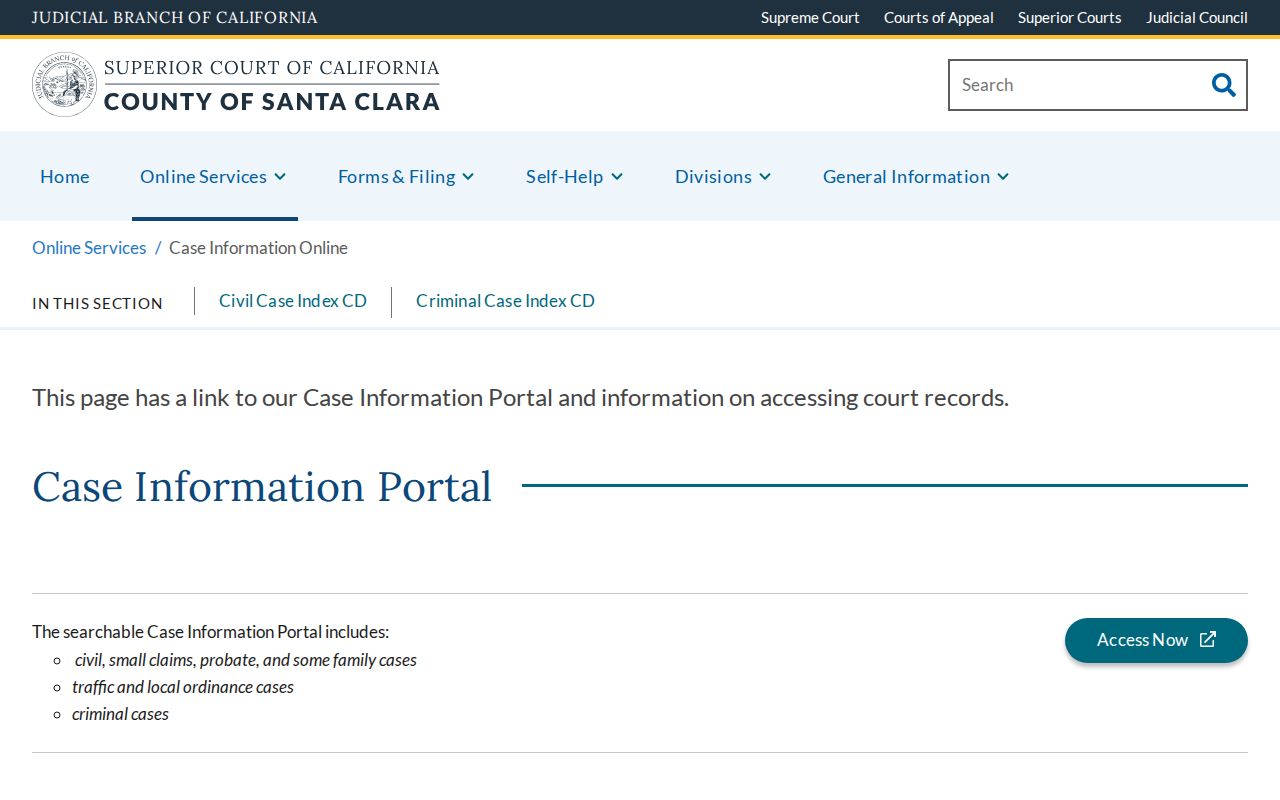
The portal image supports the online search route, but formal copy rules still come from the court's criminal records instructions and Clerk's Office process.
Santa Clara Courthouse Routing
The research highlights a local advantage: Santa Clara County maps criminal matters by courthouse. This helps when the person knows the arrest city but not the case number. Hall of Justice at 190 West Hedding Street in San Jose handles criminal matters for San Jose, Milpitas, Los Gatos, Saratoga, Monte Sereno, and Santa Clara. South County Courthouse at 301 Diana Avenue in Morgan Hill handles San Martin, Morgan Hill, and Gilroy. Palo Alto Courthouse at 270 Grant Avenue handles Cupertino, Mountain View, Palo Alto, and Sunnyvale.
| Courthouse | Criminal geography from research |
|---|---|
| Hall of Justice | San Jose, Milpitas, Los Gatos, Saratoga, Monte Sereno, Santa Clara |
| South County Courthouse | San Martin, Morgan Hill, Gilroy |
| Palo Alto Courthouse | Cupertino, Mountain View, Palo Alto, Sunnyvale |
This courthouse split does not prove release. It helps route the record request. If a jail booking began in one city and the court case sits in a courthouse assigned to that city, the case number can unlock the disposition, sentence, and release order that the jail roster no longer shows.
Public Court Limits
Not every criminal-file item is public. The Criminal Case Records page excludes arrest reports, documents listing victim names, addresses, and phone numbers, probation reports, domestic violence protective orders, O.R. reports, criminal history information, and financial or medical information. A release lookup should focus on public disposition, public minutes, public sentencing information, bail actions, warrant recalls, and copy availability. It should not promise confidential reports or full case files.
Record clearance can also affect public access. The research notes local record-clearance and expungement resources through county probation and public defender channels. A dismissal, sealing order, expungement, or other restriction can change what appears in public court or agency records. When a case has been restricted, rely on the official court order and agency response rather than old search mirrors.
Confirm a Court Release
A court record confirms a legal action, not always the physical moment someone walked out of jail. A judge may order release, recall a warrant, dismiss charges, impose time served, or sentence the person to probation. The jail then processes the custody event. That means a court order and an Administrative Booking response may need to be read together. The court tells why; the custody office tells whether the person is still held or has left county custody.
- Disposition
- The public case outcome, such as dismissal, plea, conviction, or other resolution.
- Remand
- A court order sending or keeping a person in custody.
- Time served
- A sentence satisfied by custody credit already earned.
- Certified copy
- An official copy issued by the court clerk when available and requested through court channels.
For a complete Santa Clara County release confirmation, use the court portal, the sheriff's current custody search, Administrative Booking, VINE, and if needed a Sheriff's public-records request. If the case moved to state prison, use CDCR/CIRIS and the sentencing record. If the case moved to federal criminal custody, use the federal court and BOP route only after the transfer is clear.
Court Copy Requests
The court's criminal records instructions make the case number central. Once the case number is known, a requester can seek public records from the Clerk's Office. Online access may show some public case information, but the court warns that document availability varies by law and case type. Certified copies can carry fees, and some public records may need an in-person terminal or a mail or counter request rather than a web download.
For release confirmation, the most useful court copy request names the case number and asks for public records sufficient to show the release order, disposition, sentence, custody credits, probation order, dismissal, or warrant recall. Do not ask the court for Sheriff's booking records, CDCR release records, BOP records, or ICE records. Each agency keeps its own record. The court record should explain the legal action that caused or followed the release.
Court Plus Custody Check
The best Santa Clara County court release check uses a two-column comparison. If the court says bail was posted or release was ordered, Administrative Booking can confirm whether jail processing has occurred. If the court says prison was imposed, CDCR/CIRIS can confirm whether the person entered state custody. If the court says probation, Adult Probation is the local supervision route. If the court says a federal matter took over, BOP may become relevant later only after federal sentencing.
This prevents timing errors. A court order may be entered before the jail completes processing. A person may be sentenced before the state receives the person. A warrant recall may not instantly clear every related hold. The court record explains the order, while custody records confirm the custody status that followed.
Public Record Search
Sponsored Results