
CDCR Parole Is State Supervision
CDCR Division of Adult Parole Operations is a supervision agency, not a jail, court, or county roster. It becomes relevant when a person was sentenced from Santa Clara County to state prison and released to state parole. The research says DAPO is geographically divided into Northern and Southern regions and has more than 92 parole units statewide. Field parole units supervise people subject to state parole and people serving certain alternative custody programs.
That state parole route should not be confused with Santa Clara County probation, PRCS, mandatory supervision, or pretrial supervision. A person can leave county jail with no supervision, local supervision, or a state parole obligation depending on the case. A person can also leave state prison to county PRCS instead of CDCR parole. The correct agency depends on the sentence, statute, and court or CDCR classification.
| Status | Agency to check |
|---|---|
| State parole after prison | CDCR DAPO and CDCR records |
| Parole suitability hearing | Board of Parole Hearings results and schedules |
| County probation | Santa Clara County Probation |
| PRCS | Santa Clara County Probation and court/CDCR records |
| Mandatory supervision | Santa Clara County Probation and sentencing court |
Verify San Jose Parole
Use a step path rather than a single search box. The public user may not receive a full supervision file, but the correct agency can confirm direction where disclosure is allowed. Start with the sentencing court and CDCR/CIRIS, then use DAPO when the record points to state parole. Use Santa Clara County Probation when the record points to PRCS, mandatory supervision, probation, or pretrial supervision.
- Confirm the Santa Clara County court case resulted in a CDCR prison commitment or parole-eligible sentence.
- Search CDCR/CIRIS for current CDCR status, commitment county, admission date, and BPH context.
- Review BPH parole suitability hearing results if the case involves parole suitability.
- Use CDCR DAPO regional office information for state parole direction.
- If records show PRCS or county supervision, contact Santa Clara County Probation instead of DAPO.
The BPH results source is shown below. It helps explain parole-suitability decisions, but a grant is not the same as a person walking out the same day.
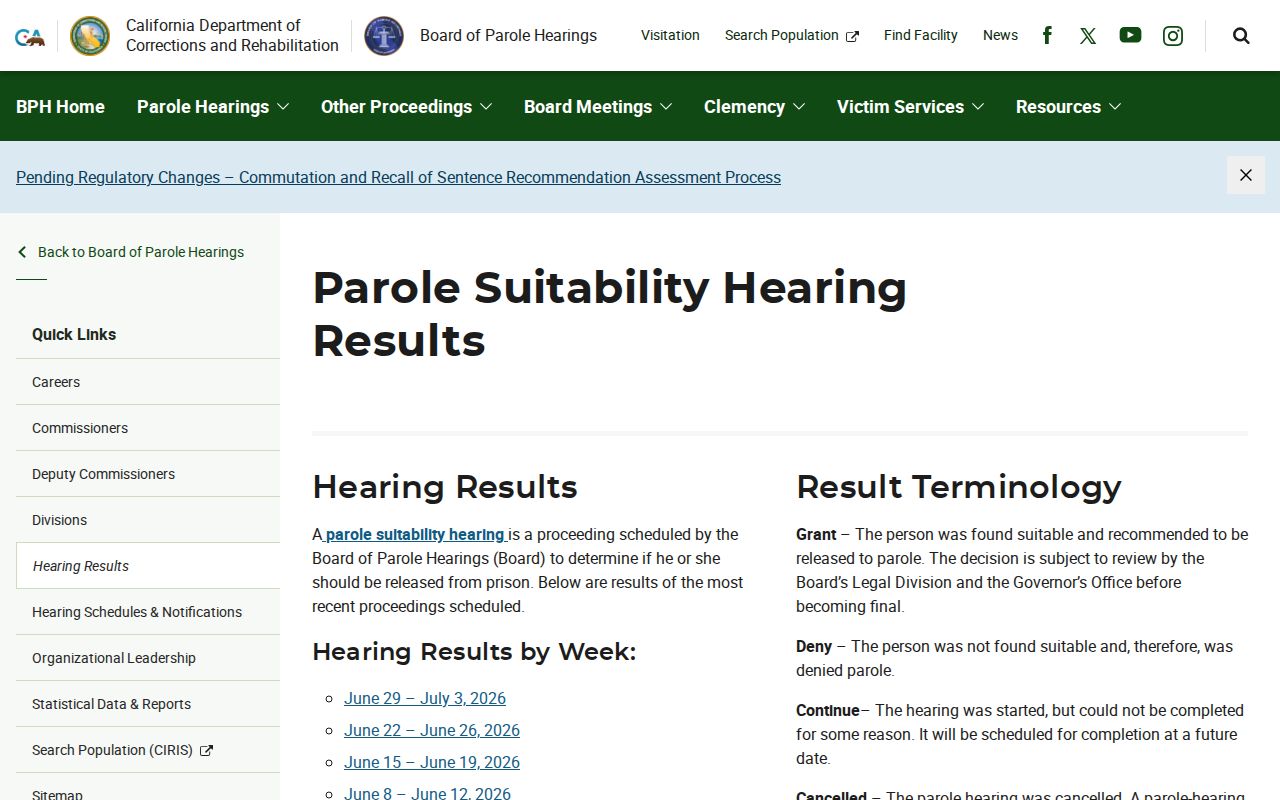
The image supports the BPH results route. Final parole status still depends on CDCR review, DAPO supervision, and the case-specific release record.
BPH Release Decision Context
The Board of Parole Hearings is part of CDCR and handles parole suitability and nonviolent offender parole review. The research says BPH hearing schedules include date, time, location, and whether hearings are in person or by video, and that schedules are updated weekly on Thursday morning. BPH results define outcomes such as Grant, Deny, Continue, Cancelled, Split, Postpone, Waive, and Stip.
A BPH grant is not a county jail release. It is a suitability finding and recommendation to release to parole, subject to review by the Board's Legal Division and the Governor's Office before finality. For a Santa Clara County case, the release trail should connect the court sentence, CDCR custody, BPH result if applicable, and DAPO supervision. If a person was never committed to CDCR, BPH is usually the wrong path.
CDCR Parole Contact Source
The DAPO regional offices page is the source for state parole structure and field parole unit routing. The research does not identify a public name-search list for San Jose parolees. That means parole verification is not a simple public roster task. A person looking for status should use the court case and CDCR record first, then contact the appropriate parole office only when the facts show state parole rather than local county supervision.
| Agency | CDCR Division of Adult Parole Operations |
|---|---|
| State context | Northern and Southern region structure, field parole units statewide |
| BPH | Board of Parole Hearings, P.O. Box 4036, Sacramento, CA 95812-4036, telephone 916-445-4072 |
| County alternative | Santa Clara County Probation for PRCS, probation, mandatory supervision, and local supervision |
Parole Versus PRCS
Santa Clara County's AB 109/PRCS layer is a required distinction. The research says Public Safety Realignment shifted some responsibilities from the state to local county Probation and Sheriff departments. Eligible people may be supervised by county Probation as PRCS clients, and some people serving local jail time under Penal Code section 1170(h) later serve a portion under mandatory supervision. That means a person released from state prison on a Santa Clara County case may report locally instead of to state parole.
The decision tree is practical. If the record says parole, use DAPO. If it says PRCS, mandatory supervision, probation, or pretrial supervision, use Santa Clara County Probation. If the record is unclear, the court sentence and CDCR record should be read before any agency contact. Using the wrong supervision agency can lead to a false "not found" result even when the person is under a valid post-release status.
Warrants and Absconders
The research found no Santa Clara County adult probation public absconder list. CDCR has specialized wanted sex-offender and registry-related public materials, but that is not a general Santa Clara County parole or probation absconder feed. For a suspected warrant, use the court docket, law-enforcement records, or direct agency contact where appropriate. Do not infer a warrant from a missing CIRIS result, a missing jail roster result, or lack of a public parole page.
When a parole violation is alleged, the public record may be split between CDCR, BPH, court activity, and jail custody if the person is returned to custody locally. Confirm the event through the agency that owns the record. A Santa Clara County jail booking after a parole event is still a jail booking, while the supervision status remains a CDCR matter unless the person is on county supervision.
Parole Discharge Records
Parole discharge is different from release from prison. Release from prison starts community supervision when parole applies. Discharge ends the parole obligation. A person may be released from CDCR custody and still be under DAPO supervision. The public court file may show the original sentence, while CDCR and DAPO records explain the parole status. If a requester needs a final discharge fact, the request should identify the CDCR number, full name, birth date if known, Santa Clara County case, and the discharge field being sought.
Do not use a county jail roster to decide parole discharge. The jail roster may show a new booking, no booking, or a release event, but it does not hold the full parole supervision file. If a parole event leads to local custody, confirm that booking through Administrative Booking and confirm supervision through CDCR or DAPO. Keeping those records separate avoids mixing a parole status with a jail custody event.
Victim Services and VINE
CDCR victim services and California VINE are related but separate notification paths. The research notes that CDCR victim services points county jail custody tracking to VINE and uses separate CDCR registration after transfer to CDCR. For a Santa Clara County person in state parole context, VINE may help with custody-status notifications, while CDCR victim services may be relevant after a state transfer. Neither source is a full public supervision file.
Use VINE for custody-change alerts, CIRIS for CDCR custody context, BPH for parole hearing decisions, and DAPO for state parole direction. Use Santa Clara County Probation only when the record says PRCS, probation, or mandatory supervision. That route is more accurate than treating all post-release supervision as one local status.
Public Record Search
Sponsored Results