
Adult Probation Is Supervision
The Santa Clara County Adult Probation Department is a local supervision agency, not a custody roster. The Adult Services Division provides assessments and sentencing services, treatment and rehabilitation opportunities, and supervision services including reentry, pretrial, realignment, and specialized probation supervision. It becomes part of a released-person search only when the court or CDCR record points to local supervision.
Probation is different from parole. Probation is a local court sentence or supervision order. PRCS is county supervision after state prison for eligible people under realignment. Mandatory supervision is the local supervision portion of certain Penal Code section 1170(h) county jail sentences. State parole is handled by CDCR DAPO. A Santa Clara County release record may name one of these categories, so the search route must follow the category.
| Local supervision type | How to confirm |
|---|---|
| Adult probation | Superior Court order and Adult Probation contact |
| Pretrial supervision | Court release order and Probation pretrial function |
| PRCS | Probation, CDCR context, and AB 109 records |
| Mandatory supervision | Sentence under local jail law and court minutes |
| State parole | CDCR DAPO, not county probation |
Verify Probation After Release
There is no public Santa Clara County adult probation name-search feed in the research. Verification is therefore document-led. Start with the Superior Court case because the court creates the supervision order. Then contact the proper county office when the record shows probation, PRCS, mandatory supervision, or pretrial supervision. If the person was released from state prison, check whether the record says PRCS or state parole before calling the wrong agency.
- Find the criminal case number through the Santa Clara County Superior Court portal or criminal case index.
- Review public minutes, disposition, sentence, release order, and supervision terms where available.
- Identify whether the status is probation, PRCS, mandatory supervision, pretrial supervision, or state parole.
- Use Adult Probation for county supervision and DAPO for state parole.
- For jail custody dates or release time, request Administrative Booking verification or a Sheriff's records response.
The Adult Probation source page is shown below. It is the source for the local supervision functions and office contact used here.
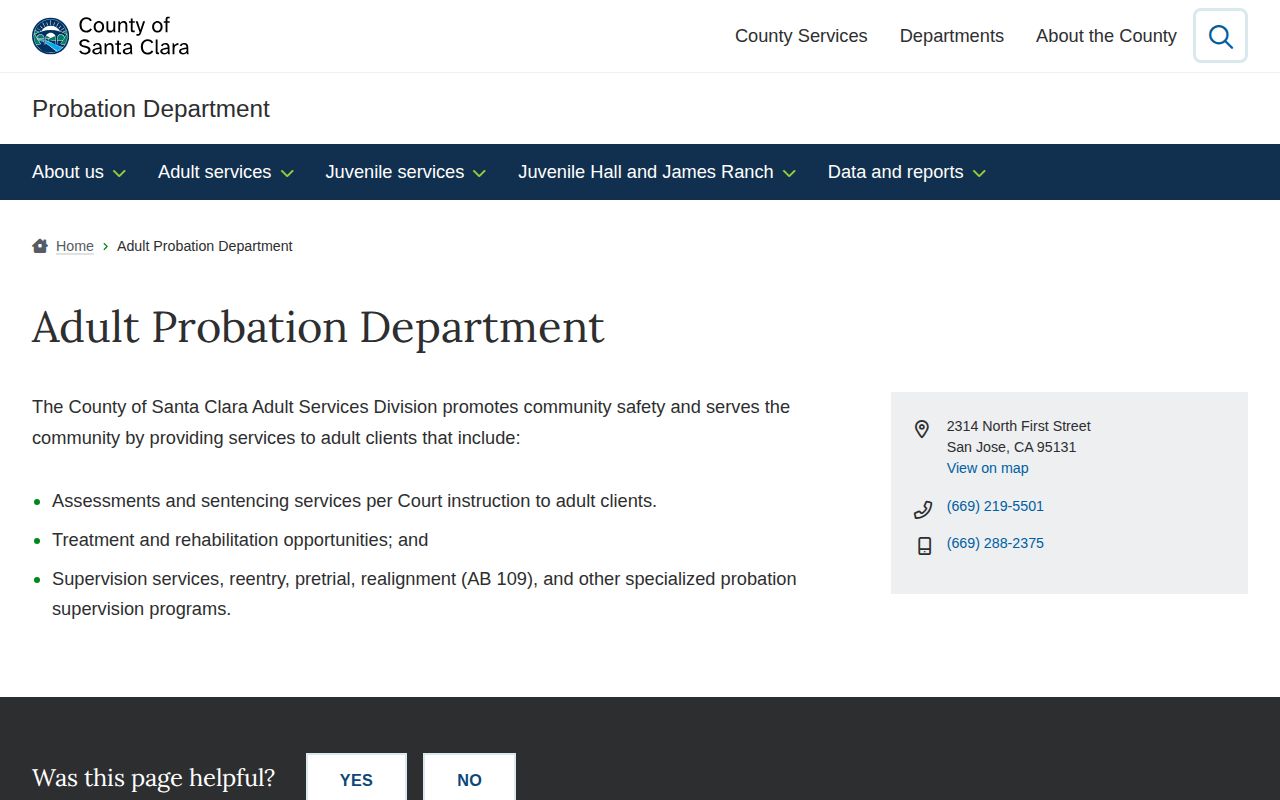
The image supports the supervision route, while the court order remains the usual public record that explains why supervision applies.
Adult Probation Contact Card
The Adult Probation office listed in the research is the main local contact for county supervision after release. Because supervision files may include restricted information, public users should expect limits. A narrow request should identify the court case and ask for general routing or public records rather than private supervision file contents. If the goal is jail release proof, the Sheriff's Administrative Booking Unit remains the better channel.
| Adult Probation | 2314 North First Street San Jose, CA 95131 (669) 219-5501 or (669) 288-2375 |
|---|---|
| General department | (408) 435-2000 Fax: (408) 456-0527 |
| Related release proof | Superior Court for orders, Administrative Booking for custody verification |
PRCS and AB 109
Santa Clara County's AB 109 layer is central to local release research. The Diversion and Reentry AB 109 page says realignment shifted some responsibilities from the state to local county Probation and Sheriff departments. It explains that eligible people may be supervised by county Probation as PRCS clients and that some local-sentence people serve a portion of local time under mandatory supervision.
This means a person released from state prison on a Santa Clara County case may not be on state parole. The person may report to county probation under PRCS. A person serving a local sentence may have mandatory supervision after custody. The decision tree should be based on the court sentence, CDCR release context, and the supervision term named in public records.
Community Corrections Records
The Community Corrections Partnership adds policy and data context, not a person-name lookup. The research says the CCP meets quarterly and includes updates from Diversion and Reentry Services, Probation, law enforcement, and community partners. Data is shared on reentry clients and service use, and Probation presents realignment-client information.
That public planning layer explains why Santa Clara County has local supervision and reentry records beyond the jail roster. It does not confirm whether one named person is on probation. Use it as context for PRCS and realignment, then use court orders and agency contact for a specific released person.
Warrant Status Limits
No Santa Clara County adult probation public absconder list was found in the research sweep. A suspected warrant or violation should be checked through the court docket, law-enforcement records, or direct agency contact where permitted. Do not infer a warrant from a missing probation webpage or a missing jail roster result. A person may be off the roster because release, transfer, record limits, or another custody authority applies.
Probation violation and warrant records can involve court action, jail booking, and probation supervision. If a violation leads to custody, the county jail search may show a new booking. If the violation is handled in court, the court minutes may show the event. If the person is on state parole, DAPO and CDCR routes apply instead.
Probation Record Boundaries
Probation records can include restricted supervision material. The court's criminal records page also excludes probation reports from public criminal-file access. That does not mean probation has no public role. It means the public release check should focus on public orders, docket entries, supervision category, and agency routing. A person seeking official proof of jail release should use Administrative Booking. A person seeking public case disposition should use the court. A person seeking supervision direction should use Probation when the public record shows local supervision.
A narrow request is more likely to stay on the correct side of those boundaries. Identify the case number, full name, date of birth if known, and the public supervision category. Ask where to verify probation, PRCS, mandatory supervision, or pretrial supervision status. Do not ask for confidential reports unless a legal right of access exists.
Probation and Reentry
Probation connects to Santa Clara County's reentry structure because AB 109, PRCS, and mandatory supervision can involve local service coordination. The Reentry Resource Centers in San Jose and Gilroy are service hubs, while Adult Probation is the supervision agency. They are related in the local release ecosystem, but they serve different roles. Reentry centers do not prove release, and Probation does not replace the court order that creates supervision.
For a person released from county jail, the record trail may be Main Jail or Elmwood, Superior Court, Adult Probation, and reentry services. For a person released from state prison to PRCS, the trail may be CDCR, the Santa Clara County case, Adult Probation, and reentry services. Each step should be verified through the source that owns that part of the record.
Probation also helps explain why a person may be out of custody but still have court obligations. A released person may need to report, comply with conditions, return for hearings, or complete a local supervision term. Those details are not the same as the release date. The release date belongs to the custody record, while supervision terms belong to the court and Probation records that can be disclosed.
Public Record Search
Sponsored Results