
Reentry Centers Are Not Jails
Santa Clara County Reentry Resource Centers are operated through the county's Office of Diversion and Reentry Services with county and community partners. The research identifies centers in San Jose and Gilroy and describes their role as local service hubs for justice-involved residents. They are not inmate locators, recent-release feeds, court indexes, or probation rosters. They explain what can happen after release, not whether a named person was released on a specific date.
That distinction protects the accuracy of the release search. If the question is "is the person out of jail," use the Santa Clara County inmate search, Administrative Booking, VINE, and the Superior Court record. If the question is "what local systems may be involved after release," the Reentry Resource Centers and AB 109 material are relevant. The reentry system sits beside official records; it does not replace them.
| Need | Route |
|---|---|
| Confirm jail release date | Administrative Booking or Sheriff's records request |
| Confirm court reason for release | Superior Court criminal case record |
| Confirm PRCS or local supervision | Santa Clara County Probation and court order |
| Find reentry service context | Reentry Resource Centers and Diversion and Reentry Services |
| Confirm state parole | CDCR DAPO and CDCR/CIRIS |
Use Reentry After Release
The Diversion and Reentry Services home page identifies the county's reentry structure and centers. The research says the centers operate with county departments, community organizations, and law-enforcement partners to streamline access to services and reduce barriers after incarceration. That makes the centers locally important for people returning from jail or prison, and for family or legal coordination around local service navigation.
- Confirm release or transfer first through the jail, court, VINE, CDCR, BOP, or ICE route that fits the custody type.
- Identify whether supervision is probation, PRCS, mandatory supervision, state parole, or none found in the public record.
- Use Santa Clara County Probation when the record points to county supervision.
- Use Reentry Resource Centers for local service navigation and AB 109 context, not for official custody proof.
- Keep the case number, PFN, booking number, and release date separate from service notes.
The Diversion and Reentry AB 109 source is shown below. It documents the local realignment layer that affects some release paths.
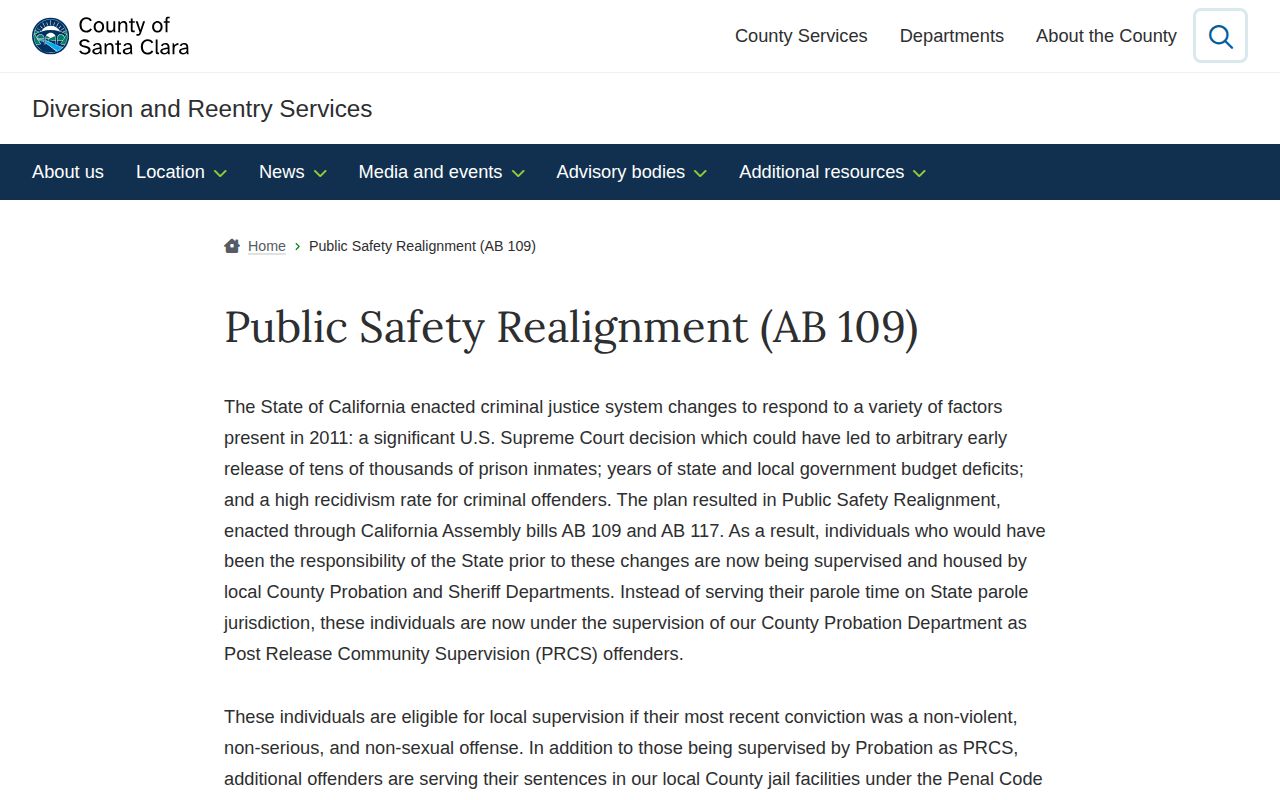
The image supports the local reentry context, while release confirmation must still come from the agency that maintains the custody or court record.
AB 109 Reentry Layer
Santa Clara County's AB 109 information explains why reentry is part of a release-record site even though it is not a search database. Realignment shifted some responsibilities from the state to local county Probation and Sheriff departments. Eligible people may be supervised by county Probation as PRCS clients. Some people sentenced under local jail law may serve a portion under mandatory supervision. These local categories can appear after a county jail release or after a state-prison release tied to a Santa Clara County case.
PRCS and mandatory supervision are not the same as state parole. State parole belongs to CDCR DAPO. PRCS and mandatory supervision belong locally with county probation. Reentry centers help explain the local service environment around those statuses, while the court order and supervision agency provide confirmation for a named person.
Reentry Source Card
The research provides a public contact block for Diversion and Reentry Services and states that Reentry Resource Centers operate in San Jose and Gilroy. It does not provide a named-person release lookup at those centers. A person seeking records should not send a custody verification request to a service hub when the requested proof belongs to the Sheriff's Office, Superior Court, CDCR, or Probation.
| Agency | County of Santa Clara Office of Diversion and Reentry Services |
|---|---|
| Reentry Resource Centers | San Jose and Gilroy service hubs |
| Public contact | (408) 535-4299 |
| Official release proof | Administrative Booking, Superior Court, CDCR, Probation, BOP, or ICE depending on custody type |
After Custody Records
A released person may have several records after leaving custody. The jail release record shows the custody event. The court record shows the legal reason, sentence, credits, or disposition. Probation or CDCR records show supervision. VINE shows custody-status notification when available. Reentry records and service referrals sit in a different lane. They may help explain the local post-release environment, but they are not proof that a person was released on a specific day.
For Santa Clara County, the strongest path is to confirm the release first, then determine whether reentry services or local supervision are relevant. A person released with no supervision may still seek services. A person on PRCS or mandatory supervision may have both Probation involvement and reentry service options. A person on state parole may also need local services, but parole status remains a CDCR matter.
Reentry Versus Supervision
Reentry services and supervision are often discussed together, but they are not the same record. Supervision is a legal status created by a court, CDCR, or statute and managed by Probation or DAPO. Reentry is a local service and navigation structure. A person may use reentry services with or without a public supervision status. A person may also be on probation or PRCS without a public service record appearing online.
For release confirmation, ask which record is needed. Custody date and release manner belong to the Sheriff's Office. Disposition and sentence belong to the Superior Court. PRCS and local supervision belong to Probation. State parole belongs to DAPO. Service navigation belongs to Diversion and Reentry. This division keeps the release record accurate and prevents a service contact from being mistaken for proof of custody status.
Public Record Search
Sponsored Results